ESMC sets out Five Recommendations to Turn a Weak Industrial Accelerator Act proposal into a real industrial instrument
Brussels, 29 April 2026 – The European Solar Manufacturing Council (ESMC) is calling on EU policymakers to strengthen the proposed Industrial Accelerator Act (IAA) significantly, in order to secure resilient clean-tech value chains and restore European solar manufacturing capacity. In a position paper, the business association, which represents over 60 European solar PV producers and research organisations, calls for five key amendments to transform the IAA into an effective instrument for supporting the European cleantech industry. Alongside many other stakeholders, the ESMC believes that the current proposal is too limited in scope, too slow to implement, and too ineffective at growing the European PV industry.
‘Energy has become a matter of security. Decentralised solar and storage systems have proven to be more resilient than centralised infrastructure, both for on-grid and off-grid applications, such as satellites and defence systems. These are compelling reasons to invest in Europe’s industrial capacity,’ said Christoph Podewils, Secretary General of ESMC.“By taking decisive action, Europe can establish an industrial ecosystem that will contribute to both economic security and the physical safety of its member states.”
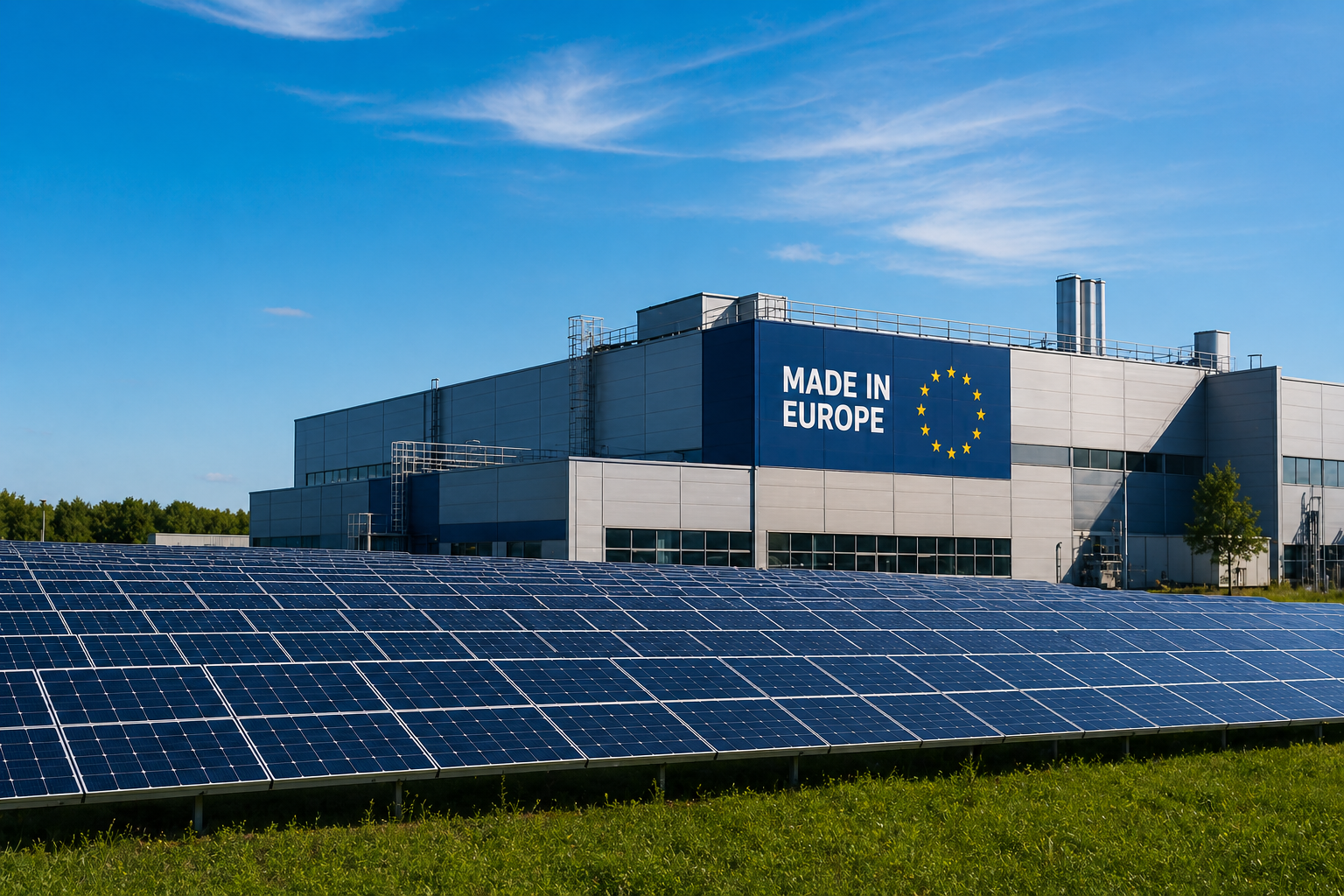
The most important ESMC recommendation is to give ‘Made in Europe’ real meaning. However, the IAA proposal currently only covers cells and inverters, which are two of the eight main components in the PV value chain. This criterion must be extended to at least three components and applied to at least half of the publicly tendered PV capacity. Equally importantly, the IAA should be a truly European instrument that focuses on European countries rather than including up to 40 non-European countries that have free-trade agreements with Europe, as is envisaged in the proposal.
“With the current IAA proposal, Chinese manufacturers will simply reroute production through third countries. This would not benefit European industry”, Podewils criticises.
The same logic applies to public funding: China should be regarded as a high-risk supplier because Europe currently depends on the country for 80 to 100 per cent of critical PV components. Control over this technology means control over Europe’s economic and energy infrastructure systems.
At the same time, the EU must govern foreign capital entering its industry more effectively. Therefore, the EU should impose stricter conditions on foreign investment in the IAA. For investments of more than 100 million euros, entering into a joint venture with a European partner should be mandatory fort he foreign entities, not optional. Local sourcing requirements for such projects should increase from 30 to 50 per cent. Foreign entities with a history of IP infringement against European companies and research organisations should be prohibited from profiting from these infringements in Europe and denied access to the European market altogether.
Accordingly, public funds used to develop a European solar industry should also benefit European equipment suppliers. This would not only secure and create skilled jobs in machine construction, but also foster the development of advanced PV production equipment and facilitate innovation for European PV research institutions, which remain at the forefront of global research but currently lack industry partners within Europe. To support this endeavour, the share of equipment manufactured in the Union should correspond proportionally to the level of public funding granted — ensuring that taxpayers’ money strengthens European industry rather than foreign competitors.
However, these measures will only be effective if an improved IAA enters into force in a timely manner, as the European PV manufacturing industry is being seriously harmed by the overcapacities and dumping practices of many Chinese competitors for years now. For this reason, the PV part of the Industrial Accelerator should come into effect in the first half of 2027.
The Commission’s own Impact Assessment confirms that stronger measures would barely influence consumer electricity prices, while the economic and geopolitical opportunities of an improved IAA are significant. ‘Now is the time to turn the tide from factory closures to renewed investment in European solar manufacturing’, said Christoph Podewils. ‘We call on the Members of the European Parliament and the Member States to use their power to support a domestic solar industry that can power the economy and society with affordable, safe and sustainable energy better than anyone else.’