
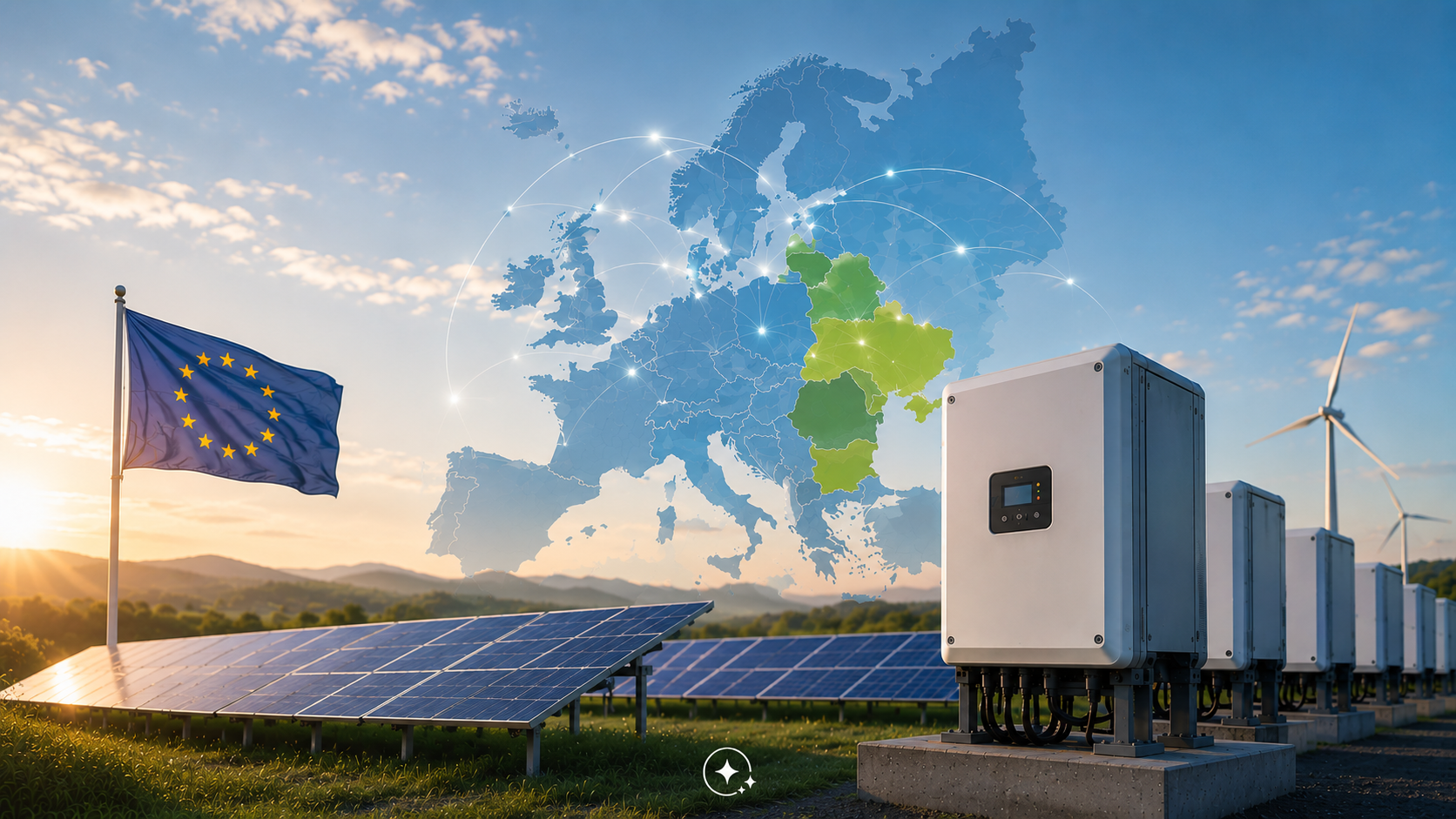
New S&P Global Energy data shows Western production capacity already exceeds the EU’s entire installation demand. Western inverter manufacturer with a multi-gigawatt installed base and local teams also in Eastern Europe – ready to scale within months as the EU phases high-risk inverters out of public funding.
Brussels, 23 June 2026 – As the European Union moves to exclude inverters from high-risk countries from EU funding, the decisive question is no longer political but practical: can Western manufacturers actually supply the market? The answer, on the figures of market intelligence specialist S&P Global Energy is unambiguous. Western production capacity already equals Europe’s entire annual installation demand. And, according to a recent ESMC survey, Western inverter makers are firmly established on the ground also across Eastern Europe – with a multi-gigawatt installed base, local service teams, and the ability to scale up substantially within months.
According to S&P Global Energy, European inverter production capacity stands at roughly 104 GWac. In addition, more than 120 GWac production capacity from manufacturers in the Americas and the Asian Pacific Region (excluding PRC) is available. The European production capacity available for European demand alone is exceeding 53 GWac, according to S&P Global Energy – this almost matches the capacity of 2025 solar installations in the EU. “Supply is not the bottleneck. The capacity to replace high-risk vendors already exists today,” said Christoph Podewils, Secretary General of ESMC.
Western manufacturers are already established across Eastern Europe
The picture in Eastern Europe is just as clear. An ESMC survey among six Western manufacturers found a combined installed base of around 14 GW across eight markets, a presence dating back to roughly 2010, some 330 sales and service staff on the ground or dedicated remotely, and the ability to scale up sales and support substantially within about six months. These are not newcomers parachuting in to chase a regulatory opening – they have been operating in the region for the better part of fifteen years.
Poland leads the way: all six surveyed Western manufacturers are active there, with an installed base of 4,430 MW, roughly 74 dedicated staff, and the ability to scale within three months. Hungary (1,831 MW), the Czech Republic (1,468 MW), Romania (1,147 MW), Bulgaria (810 MW) and Slovakia (364 MW) complete a footprint spanning Central and South-Eastern Europe. In every one of these markets, five or six of the six surveyed manufacturers are already present and locally supported. As there are more Western suppliers active in Eastern Europe, those numbers mark a conservative assessment and actual representation of Western suppliers is even higher.
A small price for energy security
Nor does energy security come at a prohibitive price. On Wood Mackenzie analysis, choosing a Western inverter adds only around 2% to the cost of a utility-scale or commercial project – negligible at system scale – and 3–4% for residential string inverters (up to 8% for systems built on micro-inverters, power optimisers or hybrid inverters). Crucially, Eastern EU markets are broadly in line with Germany and Spain: there is no structural cost disadvantage to buying Western in the East.
“The inverter is the brain of every solar installation. Who controls the brain controls the grid. The debate about whether Europe can wean itself off high-risk inverters is over – the capacity is there, the manufacturers are there, and in Eastern Europe they have been there for fifteen years,” Podewils added.
The figures were presented against the backdrop of the EU’s decision to stop public money flowing into energy projects that rely on inverters from vendors owned or controlled by entities from high-risk countries – China, Russia, Iran and North Korea. The measure applies across the EU’s financial instruments and, by design, cannot be circumvented by relocating production or setting up subsidiaries in third countries.